



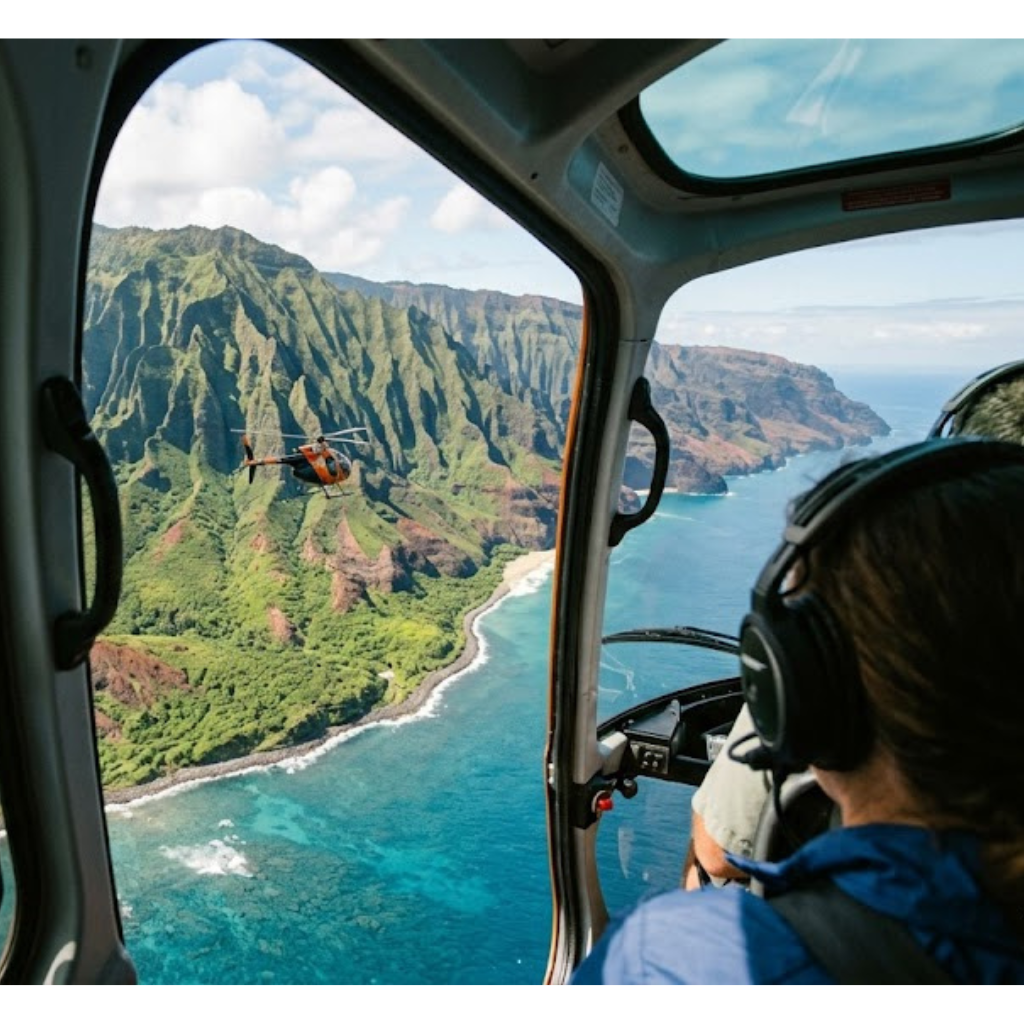
Doors-Off Helicopter Tours in Kauai: Private Charter vs Scheduled Tours for Photographers
- 5:44 PM
If photography is the reason you're booking a helicopter tour, the configuration of your flight matters more than almost anything else. Doors-off helicopter tours in Kauai give photographers a real advantage over doors-on flights, but the question of private charter vs scheduled tours for photographers is just as important as the doors question, and far fewer people ask it before they book.
At Aliʻi Kauai Air Tours and Charters, every flight we operate is private. We've been flying this island for over 32 years, and we've seen what photographers walk away with when they have full control of the aircraft versus when they share it with strangers on a fixed schedule. The difference is significant.
Here's what you need to know before you decide.
Why Doors Off Is the Only Real Option for Aerial Photography in Kauai
A doors-on helicopter puts glass between you and your subject. On a bright Kauai morning over the Na Pali Coast, that glass introduces glare, reflection, and color distortion that no amount of post-processing fully corrects. You can press your lens against the window and lose sharpness. You can angle away from the reflection and lose the shot entirely.
A doors-off configuration removes that problem at the source. Nothing between your lens and the subject. No reflection. No glare. Natural light reaches the interior of the aircraft the way it would if you were standing in an open field.
For aerial photography in Kauai specifically, this matters because the island's best subjects require precise angles. Waimea Canyon's depth only reads correctly when you can look straight down into it. The Na Pali Coast sea cliffs show their full scale when you can angle laterally without a window frame cutting the frame. Manawaiopuna Falls photographs differently from directly above than from a slight forward angle, and getting that angle requires the freedom to move your camera without obstruction.
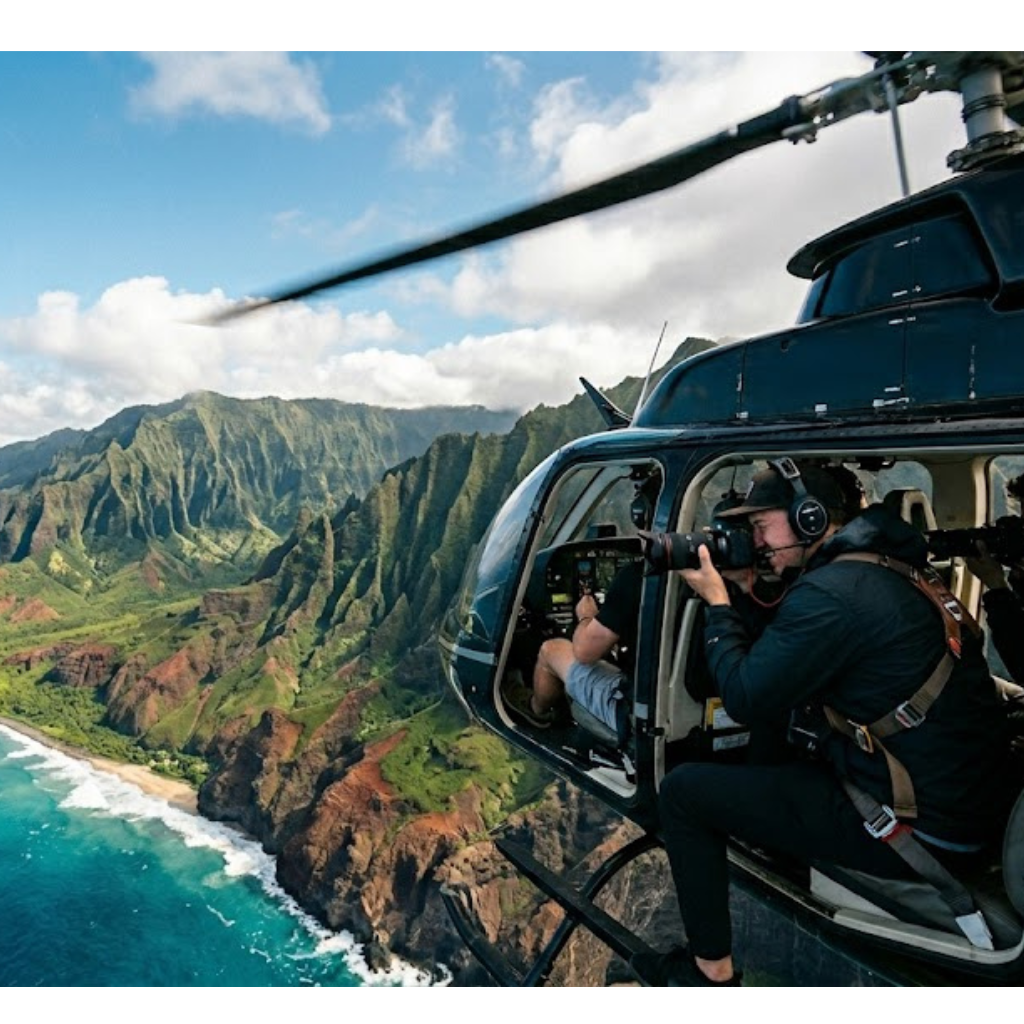
What Doors Off Actually Changes About Your Shot
The Robinson R44 that Aliʻi flies in doors-off configuration gives each rear passenger a direct, unobstructed lateral view. There's no bulkhead blocking the forward angle from the rear seat the way there is on some other aircraft configurations.
What that means practically: you can shoot across the cabin to the opposite side when the light is better there. You can angle your lens at roughly 45 degrees down into a canyon without the door frame cutting your composition. You can shoot toward the front of the aircraft when the pilot positions the nose toward a waterfall.
The open cabin also eliminates vibration transmitted through glass contact. When you hold a camera against a helicopter window for stabilization, you pick up airframe vibration directly. In a doors-off aircraft, you're braced against your own body, which actually gives you more control over camera movement at slower shutter speeds.
Private Charter vs Scheduled Tours for Photographers: What Each One Actually Gives You
This is the comparison that most photography-focused travelers skip when they research private doors-off helicopter tours in Kauai, and it's the one that most directly affects the images they come home with.
A scheduled tour runs on a fixed departure time with a fixed route. The pilot follows that route regardless of where the best light is that morning, regardless of what you want to photograph, and regardless of how long you'd like to linger over the Waimea Canyon ridgeline. If there are other passengers on the flight, every positioning decision the pilot makes is a compromise between multiple people's priorities.
A private charter gives your group the aircraft. The route is still guided by the pilot's expertise and by safety, but you have real input. Before the flight, you can tell the pilot which landmarks matter most to you, whether that's the interior of Mt. Waialeale crater, the specific angle of the sea cliffs at the start of the Na Pali Coast, or the falls in the Hanapepe Valley. The pilot can circle, reposition, and pace the flight around what your group actually needs.
That input alone changes the quality of what you shoot.
The Seat Position Problem on Scheduled Helicopter Tours
Seat assignment on a shared scheduled tour is determined by weight and balance, not by your photographic priorities. If you weigh less than another passenger, you may end up in a seat that puts the best landmarks on the opposite side of the aircraft for the entire flight.
On a shared six-passenger helicopter, at least one person typically sits in a position with limited lateral access. Middle rear seats exist on some aircraft. Bulkheads limit forward angles from rear positions. When the helicopter approaches the Na Pali Coast from the south, whoever is on the left side of the aircraft gets the first clear view. Whoever is on the right waits for the pilot to bank.
The Robinson R44 that Aliʻi operates seats three passengers. No middle seat. Every seat has direct window access. When Aliʻi flies private, every person in your group gets a shooting position, not a compromised one.
What Photographers Should Prioritize When They Book a Kauai Helicopter Flight
Flight duration is the first variable. A 60-minute flight covers the full island. Shorter tours cut landmarks. If you want the Na Pali Coast, Waimea Canyon, Manawaiopuna Falls, Hanalei Valley, and Mt. Waialeale crater in a single flight, 60 minutes is the minimum. Don't book less.
Departure time matters for light. Morning flights generally give you cleaner skies and harder directional light, which reads well on canyon walls and sea cliffs. The Na Pali Coast faces northwest, so morning light hits it from behind as you approach from the south. That can work well or require the pilot to reposition depending on what you want.
Ask any operator, before you book, whether you can communicate your shooting priorities to the pilot before takeoff. On a private charter, that conversation is standard. On a scheduled shared tour, it typically isn't possible.
Also ask directly: how many passengers will be on the flight, and does everyone get a window seat? If the answer to the first question is "up to six" and the answer to the second is a non-answer, book elsewhere.
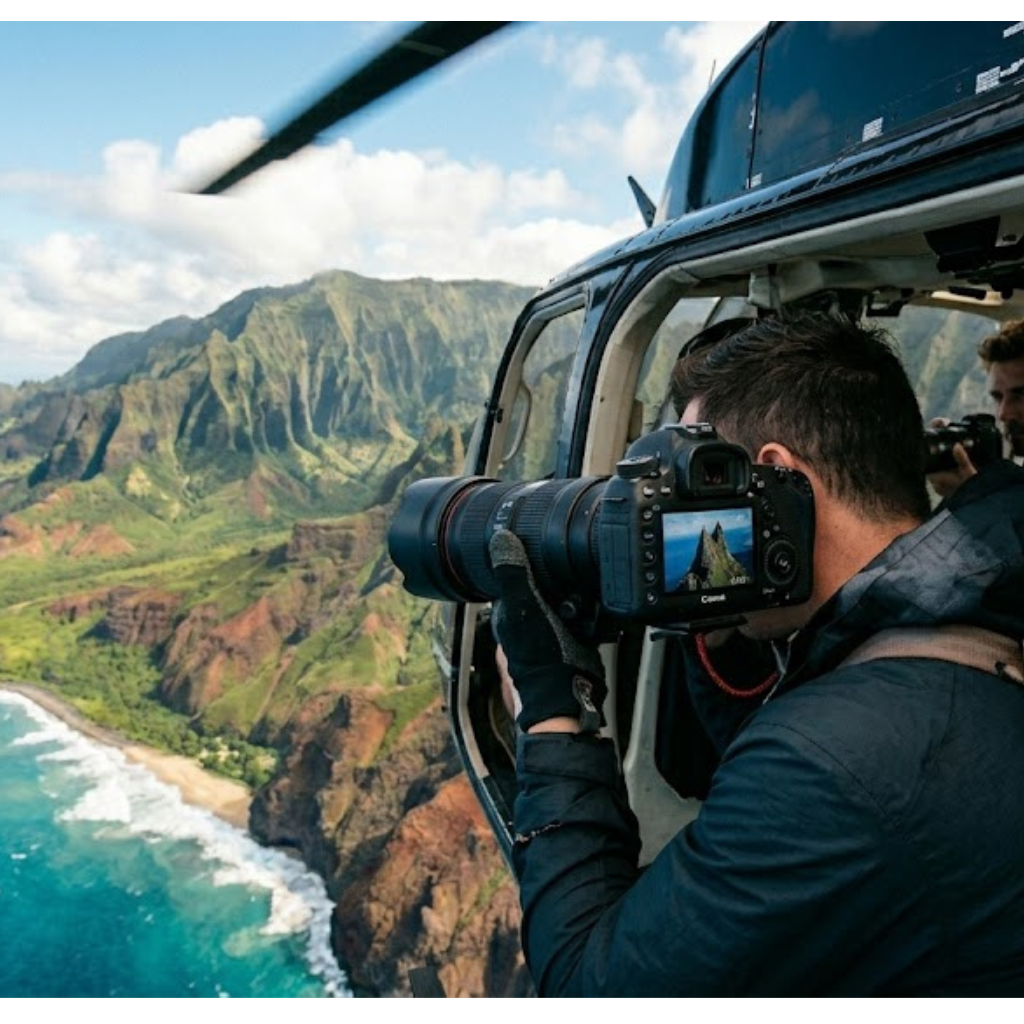
How Aliʻi Private Charters Work for Photography Clients
Every Aliʻi tour is private by default. Minimum party is two passengers. No one outside your group will share your aircraft.
Before your flight, talk to your pilot about what you want to prioritize. Aliʻi pilots know this island in detail. They know which approach to the sea cliffs puts you at the best angle for late-morning light. They know how to position the R44 so both passengers in the rear have a clear view of the same landmark at the same time.
The standard one-hour private route covers Manawaiopuna Falls in the Hanapepe Valley, the Olokele and Waimea Canyons, the Na Pali Coast with its 3,500-foot sea cliffs, the valleys of Nualolo and Kalalau, and Hanalei Valley on the North Shore. That's the full island. The pilot guides the sequence, but the pace reflects your group's needs.
Aliʻi also offers private helicopter charters for photographers who want to concentrate on specific sections of the island. If your project requires extended time over a single location, contact us directly to discuss what that looks like operationally.
Book the Right Kauai Doors-Off Helicopter Tour for Your Photography Goals
The question of doors-off helicopter tours in Kauai private charter vs scheduled tours for photographers has a direct answer: if photography is your reason for booking, a private charter is not an upgrade. It's the correct configuration for the goal.
Shared scheduled tours are built around a general visitor experience. Private charters are built around your group's priorities. For a photographer, those are different products, not just different price points.
Aliʻi Kauai Air Tours and Charters has operated private, doors-off helicopter tours on Kauai for over 32 years. Every flight is exclusive to your party. Every seat has a window. Every pilot knows this island well enough to position the aircraft for your best shot.
Contact us at iflykauai.com to discuss your flight and your shooting priorities before you book. We'll tell you exactly what to expect.
*The Federal Aviation Administration requires that any commercially operated aircraft that operates over water must have a minimum of 2 engines. This is because in the event of an engine failure the aircraft can continue to fly to a suitable landing area.
Reference CFR 135.183 (c)